T8 and T12 bulbs are fluorescent tube lights that produce light via a mercury‑vapor discharge and phosphor coating. It can be confusing to choose between T8 and T12 bulbs because they often look similar, use the same common bi-pin base, and come in many of the same nominal lengths. However, there are differences between T8 and T12 lights in diameter, ballast requirements, energy efficiency, and output.
In this guide, we’ll break down T8 vs. T12 bulbs from a practical lighting and indoor-gardening perspective. We’ll clarify their differences, explain when they can or cannot be interchanged, and look at which lighting options are most effective for growing plants.
Finally, we’ll compare traditional T8/T12 fluorescent tubes with LED bulbs for growing plants, which offer higher plant-focused output, full-spectrum performance, and more efficient control for modern grow tents, shelves, and indoor gardens.
Table of Contents
Are T8 and T12 Bulbs the Same Length?
Yes, T8 and T12 bulbs are generally the same nominal lengths, but they differ in diameter and wattage. Both T8 and T12 use common nominal lengths like 2 ft (≈600 mm), 4 ft (≈1,200 mm), and 5 ft (≈1,500 mm).
Are T8 and T12 Bulbs the Same Length?
T8 and T12 share the same G13 bi‑pin base, so a T8 tube can often fit into a T12 fixture if the length matches. However, you should also check the electrical compatibility (ballast).
What Are the Differences between T12 and T8 Lights?
T8 and T12 lights differ mainly in diameter, efficiency, and ballast type, even though they share the same G13 base and common lengths.
A comparison chart of their key parameters is below.
|
Parameters |
T8 |
T12 |
|---|---|---|
|
Diameter |
1 inch (8/8″ ≈ 25.4 mm) |
1.5 inches (12/8″ ≈ 38.1 mm) |
|
Base Type |
G13 medium bi‑pin (0.5″ pin spacing) |
|
Common Lengths |
2 ft, 3 ft, 4 ft, 8 ft |
|
Typical 4‑ft Wattage |
~32 W (standard), down to ~25 W (high‑efficiency) |
~38 W (standard) |
|
Efficacy (lumens per watt) |
~80–100 lm/W (with electronic ballast) |
~50–70 lm/W |
|
Ballast Type |
Electronic T8 ballasts (modern) |
Magnetic T12 ballasts (older); some electronic |
|
Energy Efficiency |
Higher; roughly 20–35% less energy for similar ligh |
Lower; more watts for similar light |
|
Average Rated Life |
~24,000–46,000 hours (ballast/switching dependent) |
~12,000–20,000 hours |
|
Heat Output |
Lower (less waste heat per lumen) |
Higher |
Also, we’ve tailored this to grow‑light applications, focusing on PPFD/DLI performance, spectrum options, and practical LED retrofit paths.
Here are differences between T8 and T12 bulbs for indoor growing.
|
Parameters |
T8 |
T12 |
What it Means for Plants |
|---|---|---|---|
|
Diameter |
1 in (25.4 mm) |
1.5 in (38.1 mm) |
Same fixture length; T8 is slimmer and easier to pack closely over canopy. |
|
Typical 4‑ft Wattage |
~32 W (standard), ~25 W (HE) |
~38 W (standard) |
T8 gives similar or higher light with less power and heat. |
|
Efficacy |
~80–100 lm/W (electronic ballast) |
~50–70 lm/W |
Higher lm/W → more photons per watt → better PPFD at the same energy cost. |
|
Typical PPFD at Canopy |
Moderate; drops quickly beyond ~6–12 in |
Lower; needs to be very close to canopy |
Both are best for seedlings, propagation, and low‑light foliage; less ideal for high‑light fruiting without many tubes. |
|
DLI Capability |
Good for low–medium DLI (e.g., herbs, leafy greens) with long photoperiod |
Similar or lower DLI unless densely packed |
For high DLI crops (tomatoes, peppers), fluorescents require many tubes and long run times; LEDs scale better. |
|
Spectrum Options |
Cool white (6500K), warm white (3000K), some “grow” tubes with extra red |
Mostly cool/warm white; older “grow” versions with red peaks |
Fluorescents tend to be blue‑heavy; better for vegetative growth than flowering unless using specialized red‑enhanced tubes. |
|
Heat at Canopy |
Lower than T12, but still notable in tight spaces |
Higher heat per lumen |
Less heat = you can hang lights closer, improving PPFD without scorching. |
|
Ballast Type |
Electronic T8 ballasts |
Magnetic T12 ballasts (older) |
Electronic ballasts are more efficient and stable; magnetic T12 ballasts add losses and can flicker. |
|
LED Retrofit Path |
T8‑style LED grow tubes (ballast‑bypass or Type A+B) |
Same T8/T12 LED tubes after ballast bypass |
Direct‑wire LED tubes eliminate ballast losses, raise PPFD, and allow targeted spectra (e.g., 450 nm blue + 660 nm red). |
|
Best Grow Use Cases |
Seed starting, microgreens, herbs, low‑light houseplants, shelf racks |
Legacy fixtures; okay for propagation if retrofitted to LED |
For serious veg/flower, modern LED bars/panels outperform both on PPFD/DLI and spectrum control. |
Are T8 and T12 Bulbs Interchangeable?
T8 and T12 bulbs are physically compatible but not directly interchangeable in most fluorescent fixtures. They share the same G13 bi‑pin base, so a T8 tube will fit into a T12 socket (and often vice versa) if the length matches. However, since the ballast and electrical requirements usually do not match, this can cause poor performance or shortened lamp life.
Are T8 and T12 Bulbs Interchangeable?
Why Are They Not a Simple Swap?
- Same Base but Different Ballasts: T12 fixtures typically use older magnetic ballasts, while T8 systems are designed for electronic T8 ballasts. Running a T8 tube on a T12 magnetic ballast can cause flicker, reduce efficiency, and shorten lamp life.
- The Risks of Electrical Mismatch: Even if the tube lights up, mismatched current and starting characteristics can wear out the ballast or the tube faster.
Safer Ways to “Interchange” Them
- Exchange with LED Tubes: Many T8 LED tubes are rated for ballast‑bypass (Type B) or universal (Type A+B) operation, so they can be installed in T12 fixtures after removing or bypassing the old ballast. This is the most common and reliable upgrade path.
- Replace the Ballast: To use true T8 fluorescent tubes in a T12 fixture, replace the T12 ballast with a compatible T8 electronic ballast. Meanwhile, keep the same G13 sockets.

What Lighting Bulbs Are Ideal for Growing Plants?
For indoor plant growing, T8 and especially T12 fluorescent tubes can still serve basic purposes such as seed starting, propagation, microgreens, herbs, and low-light houseplants when mounted close to the canopy.
However, for growers who need stronger vegetative growth, flowering performance, and to promote plant growth, you should consider light efficiency, output, consistent coverage, spectrum quality, heat management, and cost.
To replace T8 and T12 bulbs, you can consider a long-term solution - Spider Farmer’s LED grow lights. In most setups, you’ll get better growth per watt with less hassle.
2 Packs | 2026 Newest Version Spider Farmer® SF1000 100W Full-Spectrum Dimmable LED Grow Light For 2×4′
2 Packs | 2026 Spider Farmer SF1000D 100W Full Spectrum LED Grow Lights for 4×2′ Tent 2-4 Plants
2026 New SF2000 200W LED Grow Light & GGS Smart Controller Bundle for 4’×2’/5’×3′ Coverage
- 1x SF2000 200W LED Grow Light (with dimmer box)
- 1x Power Cord
- 2x Hanging Kits
- 2x Rope Ratchets
- 1 × GGS controller (with power supply)
- 1 × GGS temperature and humidity sensor
- 1 × GGS light adapter (for connecting the lights to the GGS System)
- 1 × GGS Pro adapter (10 ports for expanding connections)
- 4 × 2.5m RJ12 cables (for connecting devices)
- 2 × 0.25m RJ12 cable
- 4 x hook and loop straps (for organizing cables)
2026 New Spider Farmer® SF2000 200W Full Spectrum Dimmable LED Grow Light For 4×2’/5×3′
2026 Newest Version Spider Farmer® SF1000 100W Full-Spectrum Dimmable LED Grow Light For 2×2’/3×3′
2026 Newest Version Spider Farmer® SF1000D 100W Full Spectrum Dimmable LED Grow Light For 2×2′
2026 Newest Version Spider Farmer® SF4000 450W Full-Spectrum Dimmable LED Grow Light For 4×4’/5×5′
2026 SF2000pro LED Grow Light & GGS Smart Controller Bundle – | 200W LED grow light | 3×3′ Coverage
- 1x SF2000pro LED Grow Light (with dimmer box)
- 1x Power Cord
- 2x Hanging Kits
- 2x Rope Ratchets
- 1 × GGS controller (with power supply)
- 1 × GGS temperature and humidity sensor
- 1 × GGS light adapter (for connecting the lights to the GGS System)
- 1 × GGS Pro adapter (10 ports for expanding connections)
- 4 × 2.5m RJ12 cables (for connecting devices)
- 2 × 0.25m RJ12 cable
- 4 x hook and loop straps (for organizing cables)
2026 SF4000 LED Grow Light & GGS Smart Controller Bundle – | 450W Full-Spectrum Dimmable LED | 4×4’/5×5′ Coverage
- 1x SF4000 LED Grow Light (with dimmer box)
- 1x Power Cord
- 4x YOYO Hanger Hook
- 1 × GGS controller (with power supply)
- 1 × GGS temperature and humidity sensor
- 1 × GGS light adapter (for connecting the lights to the GGS System)
- 1 × GGS Pro adapter (10 ports for expanding connections)
- 4 × 2.5m RJ12 cables (for connecting devices)
- 2 × 0.25m RJ12 cable
- 4 x hook and loop straps (for organizing cables)
2026 Spider Farmer® SF2000Pro 200W Full-Spectrum Dimmable LED Grow Light For 3X3′
Big Sale and Get Free GGS Smart Control Kit | Spider Farmer® SF7000 650W LED Grow Light
Here is how Spider Farmer LEDs outperform T8 and T12 for indoor growing.
|
Key Lighting Features |
Spider Farmer LED Grow Lights |
T8/T12 Fluorescent Bulbs |
Why it Matters for Growing Plants |
|---|---|---|---|
|
Photosynthetic Efficiency (PPE) |
Many Spider Farmer fixtures publish PPE around 2.5–2.9 µmol/J. Eg, the SE series lists 2.75–2.9 µmol/J depending on model. |
Usually specified in lumens rather than plant-photon efficacy, traditional fluorescent systems convert less input energy into usable PAR photons. |
Higher PPE means more photons for photosynthesis from each watt, helping reduce electricity use for a given growth target. |
|
Light Output (PPF) |
Published PPF values make sizing easier: Spider Farmer lists, for example, SE3000 at 808 µmol/s, SE5000 at 1,368 µmol/s, and SE7000 at 2,044 µmol/s. |
Output is typically given in lumens, which do not indicate how much plant-usable light reaches the canopy. PPFD falls quickly as tubes are raised. |
PPF tells you how many photosynthetic photons the fixture emits; PPFD tells you how many reach the leaves. Both are more relevant than lumens for plant growth. |
|
Canopy PPFD and Uniformity |
Board and multi-bar designs are built for broad and even coverage. |
Tubes create narrow bands of light. Reaching adequate intensity and even coverage requires several closely spaced tubes and reflective surfaces. |
Uniform PPFD helps plants grow more evenly across the full tray or tent, rather than stretching in low-light zones. |
|
Spectrum |
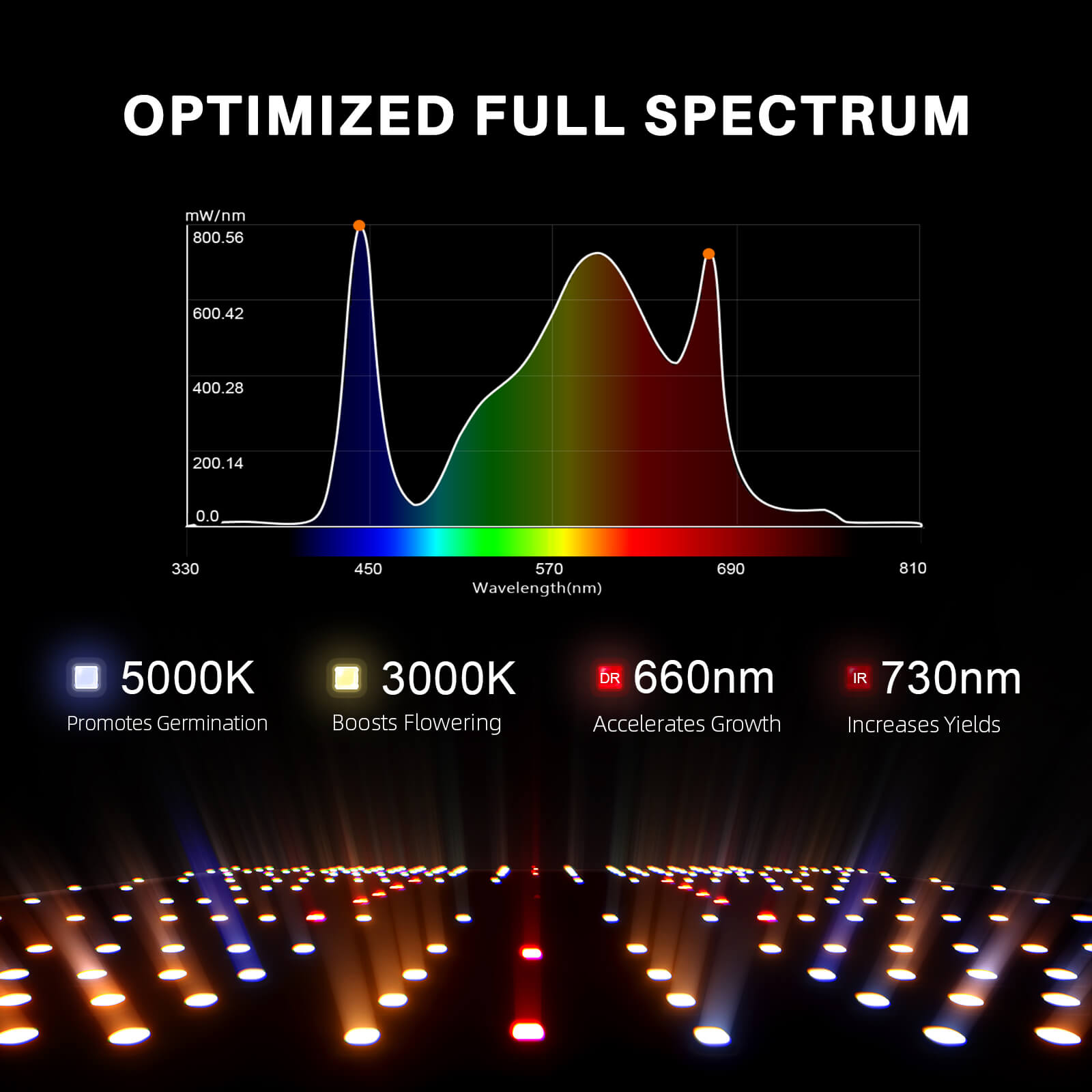
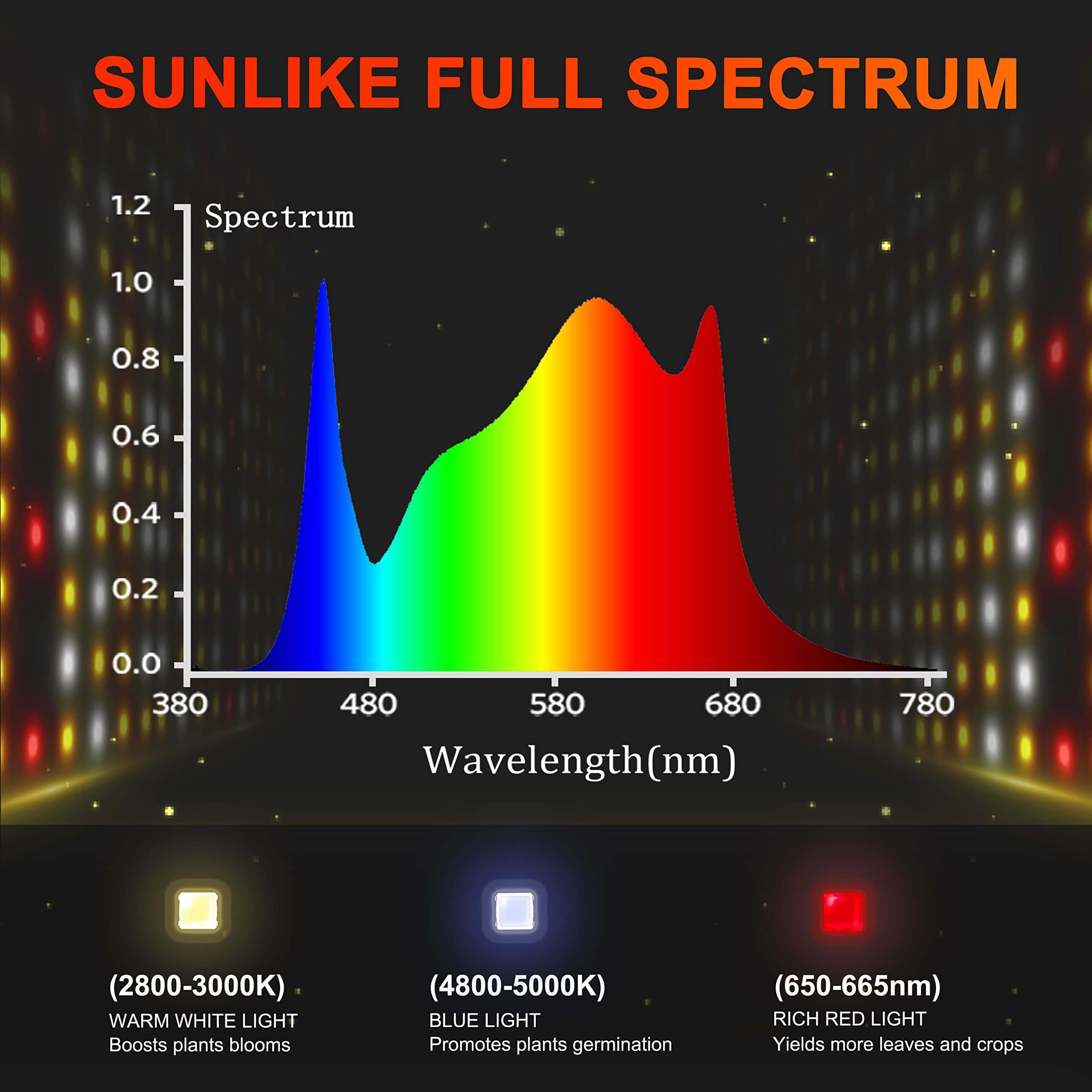
Provide a balanced, full-spectrum output that can support plants from seedling through flowering. Their fixtures combine broad white light for natural-looking, all-purpose growth with blue-rich light, warm-white light, deep red light, and far-red/IR wavelengths. |
Standard tubes are generally cool- or warm-white fluorescent lamps; specialized grow tubes exist, but spectrum selection is more limited. |
A broad white spectrum supports normal plant development, while added deep red is valuable for efficient photosynthesis and flowering/fruiting applications. |
|
Seedling through Bloom Suitability |
Designed for full-cycle cultivation—seedlings, vegetative growth, and flowering—with dimming to lower intensity for young plants. |
Best suited to propagation, microgreens, seedlings, leafy greens, and low-light foliage; often insufficient alone for demanding fruiting or flowering plants. |
High-light crops need higher PPFD and DLI than typical T8/T12 arrays can provide efficiently. |
|
Dimming and Control |
Many Spider Farmer fixtures include dimmer controls and daisy-chain capability. |
Standard fluorescent systems are generally on/off unless paired with compatible dimming ballasts and controls. |
Dimming lets growers adjust PPFD as plants develop, avoid seedling stress, and control DLI without constantly changing hanging height. |
|
Heat Management |
LED fixtures use heat sinks and spread their diodes across a board or bars, supporting heat dissipation while directing more light downward. |
Fluorescent systems run relatively cool compared with HID lamps, but need more tubes and ballasts to deliver similar usable light; total fixture heat rises as arrays expand. |
Less waste heat makes it easier to maintain leaf temperature, humidity, and VPD in a tent or grow room. |
|
Fixture Life and Maintenance |
Long-life solid-state lighting with no fluorescent tube or ballast replacement cycle; modern LED grow fixtures are intended for sustained horticultural use. |
Fluorescent tubes depreciate and eventually need replacement; fixtures also depend on ballasts, a frequent maintenance point in older T12 systems. |
Stable output helps maintain a predictable DLI over time and reduces downtime and recurring replacement costs. |
|
Scalability |
Available in compact fixtures for small spaces through high-output multi-bar fixtures, such as 4×4 and 5×5 ft grow tents and vertical operations. |
Practical on small shelves, but larger/high-light spaces require increasingly crowded tube arrays and multiple ballasts. |
LEDs scale more cleanly for larger crop areas, especially when plant density and flowering light requirements increase. |
|
Best Use Cases |
Grow tents, indoor vegetable gardens, herbs, flowering plants, fruiting crops, and growers who want measurable PPFD/DLI and lower energy use. |
Budget propagation racks, seed-starting trays, microgreens, and low-light houseplants—especially where an existing fixture is already installed. |
The right choice depends on crop light demand, growing area, operating budget, and whether you are reusing an existing fixture. |
FAQs About T8 Vs T12 Bulbs
By the end of the post, we’ll answer FAQs about T8 and T12 bulbs. Keep reading and learn more about T8 and T12 lights.
Are T12 bulbs being phased out?
Yes. T12 bulbs are being phased out in many regions because they are less efficient and have shorter lifespans than newer options like T8 and LEDs. Regulations and market shifts have even curtailed manufacturing and sales of T12 fluorescent tubes, pushing users toward T8 retrofits or direct‑wire LED replacements.
Can I replace my T12 bulbs with T8?
Physically, you can replace T12 bulbs with T8 bulbs if the lengths match, because both use the same G13 bi‑pin base and will fit in the fixture.
However, they are not a simple drop‑in electrical swap: most T12 fixtures use older magnetic ballasts that are incompatible with T8 tubes, so you typically need to either replace the ballast with a compatible T8 electronic ballast or convert the fixture to ballast‑bypass and install T8 LED tubes.
What can I replace a T12 bulb with?
A more practical upgrade is an LED tube that is compatible with T8/T12.
- For a quick swap, choose a ballast-compatible Type A LED tube.
- For higher efficiency and less future maintenance, select a Type B/direct-wire LED tube after bypassing or removing the ballast.
- For both installation options, select a Type A+B hybrid tube.
Confirm the tube’s length, pin base (commonly G13 on 4‑ft tubes), and ballast/wiring compatibility before making a purchase. If it requires ballast-bypass wiring, it should be handled by a qualified electrician.
What happens when you put a T8 bulb in a T12 fixture?
A T8 tube will usually physically fit into a same-length T12 fixture because both commonly use G13 bi‑pin sockets. However, it may not start, may flicker, or may fail prematurely because most T12 fixtures use magnetic ballasts that do not match a T8 fluorescent tube’s electrical requirements.
The proper solution is to install a T8-compatible electronic ballast or bypass/remove the old ballast and use a correctly rated T8/T12 LED tube; verify the LED tube’s ballast compatibility before installing it.
Conclusion
When comparing T12 vs. T8 bulbs, T8 is usually the more practical choice for maintaining or upgrading a traditional fluorescent fixture. Both types may share the same common tube lengths and G13 bi-pin base, but T8 tubes are slimmer and generally more energy-efficient.
However, as T12 and T8 lights are limited in PPFD, spectrum flexibility, coverage, and long-term energy efficiency, it’s better to invest in a purpose-built LED grow light. Modern Spider Farmer LED grow lights can provide exactly what growers need - higher plant-photon efficiency, full-spectrum output, dimming, improved heat management, and scalable coverage.